











How IDCUBE Transformed Visitor Management with Intelligent Access Orchestration for DGA
Overview
The Digital Government Authority (DGA) stands at the centre of the UAE’s digital transformation agenda, driving innovation, research, and the evolution of government services. Operating across multiple facilities, including the technology hub building, DGA manages a dynamic ecosystem of internal government stakeholders and external collaborators.
With approximately 2,000 employees and a steady flow of visitors ranging from government officials to technology partners, DGA required more than a conventional visitor management system. It needed a solution that could enforce strict governance, adapt to multiple workflows, and deliver a seamless experience without compromising security.
The ambition was not just to digitise visitor handling, but to fundamentally transform it, creating a policy-driven, fully orchestrated visitor ecosystem where identity, access, and movement are governed intelligently from end to end.
The Challenge
The complexity at DGA was not simply a matter of scale, but of diversity in workflows and systems. Visitor requests originated from multiple sources, including internal government portals and external platforms. Each of these systems operated some required approvals differently, while others did not; some included asset tracking, while others were time-sensitive and needed immediate processing.
This variation created a fragmented environment where there was no unified connection between visitor requests, approval workflows, access provisioning, and on-ground security validation. As a result, critical processes were handled in isolation, often relying on manual coordination to bridge the gaps between systems.
At the same time, DGA needed to integrate with a complex enterprise infrastructure that included access control systems like Honeywell EBI, scheduling platforms such as Microsoft Outlook, communication layers like email and SMS, and emerging technologies such as robotics (ongoing integration) for navigation. Each of these systems operated independently, making it difficult to achieve real-time synchronisation and consistent enforcement of policies.
The absence of a unified control layer meant that while individual components functioned effectively, the overall visitor journey remained disjointed. This not only impacted operational efficiency but also introduced potential risks in a high-security government environment where precision and accountability are critical.
The Solution
IDCUBE approached the problem by redefining visitor management as visitor journey orchestration. Instead of focusing on isolated processes, the solution introduced a central intelligence layer capable of governing the entire lifecycle of a visitor—from pre-registration to movement within the facility.
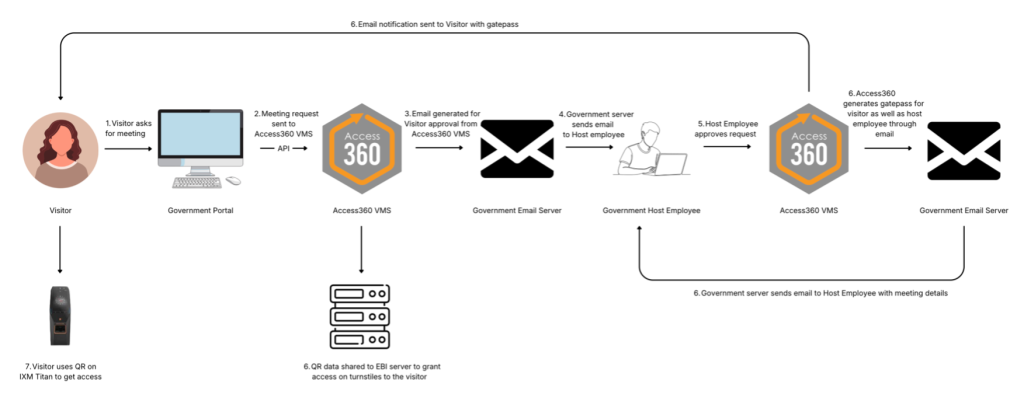
At the core of this transformation was Access360, deployed as a middleware layer that connects disparate systems and ensures seamless communication between them. Acting as the central brain of the ecosystem, Access360 integrates internal portals, external platforms, access control systems, and communication tools into a single, unified framework.
Through this central layer, every action, whether it is a visitor request, approval, credential generation, or access validation, is automatically synchronised across systems in real time. This eliminates fragmentation and enables DGA to operate with a single source of truth governing all visitor interactions.
One of the most significant aspects of the solution was its ability to handle multiple visitor journeys while delivering a consistent experience. Internal government visitors, for instance, initiate requests through the DGA internal portal without requiring approvals. Their information flows directly into the system, and QR-based credentials are generated instantly. External visitors, particularly those accessing the technology hub, follow a more structured process where requests are raised through an external portal, approvals are enforced, and asset tracking is incorporated before credentials are issued.
Despite these differences in backend workflows, both visitor types are managed within the same unified system, ensuring that policies are consistently enforced while the user experience remains seamless and intuitive.
To further strengthen security, DGA implemented a multi-layer verification model that governs movement across the facility. Upon arrival, visitors undergo an initial validation at the security checkpoint, where their QR credentials are verified. Once inside, access is restricted to approved zones, with permissions enforced through the access control system. As part of an ongoing innovation initiative, a robotics layer is being integrated to enhance navigation within the facility. Visitors can be guided to their destinations through automated verification and escort mechanisms, reducing the need for manual intervention while maintaining strict control over movement.
Beyond workflow orchestration and verification, the solution is deeply integrated with enterprise systems to enable real-time governance. Active Directory ensures that identities are synchronised automatically, while Honeywell EBI serves as the enforcement backbone for access control. Custom APIs extend the system’s capabilities, allowing for functionalities such as visitor creation with asset tracking, silent rescheduling of meetings, and real-time retrieval of visitor status.
These integrations ensure that every visitor interaction is not only processed efficiently but also validated and enforced in real time, creating a robust and auditable system that aligns with government-grade security standards.
The Impact
The transformation at DGA is evident in both operational efficiency and user experience. What was once a fragmented, manually coordinated process has evolved into a fully orchestrated, intelligent visitor journey.
Visitors are now pre-registered and validated before they even arrive, eliminating waiting times and the need for manual badge issuance. Upon arrival, they move seamlessly through a structured yet intuitive process, with each stage of their journey governed by automated validation and access control mechanisms.
From an operational standpoint, the elimination of manual coordination has significantly improved efficiency. Security teams no longer need to manage disparate systems or intervene in routine processes, as policies are enforced automatically across the ecosystem. At the same time, the multi-layer verification model ensures that security is strengthened, with every movement tracked and validated in real time.
The system also delivers complete auditability, providing DGA with full visibility into visitor interactions, access events, and movement patterns. This not only enhances security but also supports compliance and decision-making in a government environment where accountability is paramount.
Perhaps most importantly, the solution transforms the perception of the visitor experience. Instead of navigating complex processes, visitors move through a digitally orchestrated environment that reflects the innovation and efficiency of a modern government ecosystem.
Conclusion
At the Digital Government Authority, access control has evolved beyond its traditional role to become a central component of a broader, intelligent ecosystem. By integrating systems, automating workflows, and introducing a central intelligence layer, IDCUBE has enabled DGA to unify security, experience, and innovation into a single operational framework.
Through the deployment of Access360, combined with deep integrations across enterprise and physical infrastructure, DGA has successfully created a model where visitor journeys are not just managed but orchestrated with precision and intelligence.
The result is a future-ready environment where every interaction is seamless, every movement is controlled, and every decision is informed setting a new benchmark for how governments can approach access, identity, and security in the digital age.